Registered designs protect the visual appearance of a product and can be incredibly useful tools for designers to help prevent knock-offs of their products from flooding the market. However, certain aspects of a design which are dictated solely by their technical function are excluded from forming a part of registered design protection. One of the reasons for this is to prevent designs being used as a substitute for patents.
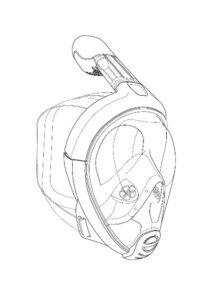
In a decision at the General Court of the European Union, the Registered EU Design for Decathlon’s ‘EASYBREATH’ full-face snorkelling mask (002526699-0001) were upheld as valid following a challenge filed by Delta-Sport Handelskontor GmbH.
Delta-Sport alleged that the design of the Decathlon mask was solely dictated by its technical function because it needed to fit a person’s face and function as a snorkelling mask. However, the General Court upheld the design, finding that there were sufficient features which were not solely dictated by technical function and which were new and had individual character over prior designs.
The EASYBREATH decision is interesting to consider with reference to the decision of the UK High Court in Chiaro v Mayborn in 2023 that the UK registered designs (Nos. 90052927030010, 90052927030002 and 90052927030003) for the Chiaro ‘Elvie’ wearable breast pump were not infringed by a similar wearable breast pump by Mayborn. One of the critical points in the reasoning was that the features which were similar in the shapes of the two breast pumps were held by the High Court to be solely dictated by technical function and therefore excluded from the scope of protection. This finding was because the shape of the wearable breast pumps needed to fit against the breast and the bra of the user, meaning that the inner and outer shapes were solely dictated by their required technical function.
It is noteworthy that both the Decathlon EASYBREATH mask and the Chiaro Elvie breast pump are items which are designed to be held against the human body – the face, for the snorkel mask and the breast, for the breast pump.
The mask must fit around the user’s face and the user needs to be able to see through the mask. Delta-Sport argued that the oval shape of the mask was dictated by technical function for this reason. Delta-Sport additionally argued that the head strap attachment was dictated by technical function.
For the breast pump, a breast pump needs to fit against the breast of the user, but was also required to fit inside the bra of the user so that the pump could be used discreetly and so, the pump needed to be shaped similarly to the breast. This further restricted the design and particularly the curved shape, of both the interior and the exterior of the breast pump.
The General Court were able to point to several aspects of the design of the Decathlon mask which they considered to not be dictated by technical function, including those which Delta-Sport had highlighted such as the strap, which was ‘X’ shaped and the specifically rounded, oval shape of the mask. The presence of a strap was dictated by technical function, but the expression of how that strap should look was not. The General Court confirmed that for the design to be valid, it is enough that just one of the features of the appearance of the product is not solely dictated by technical function.
Of course, this same principle applies in the UK and the Chiaro breast pump designs were not found to be invalid on this basis as they include some non-technical features. However, in the Chiaro v Mayborn judgement, after excluding the features dictated by technical function, the Court based their judgement on the much more minor features which remained. These minor features were the height/width/depth ratios of the breast pump and the buttons and their placement – which differed from the Mayborn pump.
Because of these features, the design registration for the Chiaro breast pump is still valid, but the scope of protection when it comes to infringement was particularly narrow once all the technical features were disregarded – and ultimately not infringed by Mayborn.
The Decathlon EASYBREATH mask had many more complex features and was restricted less by function than the breast pump as its outer surface was, broadly speaking, free in design choice. One useful insight from the Decathlon decision is how, in the case of invalidity proceedings, contemporaneous evidence discussing how aesthetic considerations were involved in the design was an objective indicator of the design not being solely dictated by technical function.
In the Decathlon v Delta-Sport, Decathlon were able to provide dated evidence to prove that the design was not exclusively dictated by technical function. Decathlon showed that, before the date of filing of the application by Delta-Sport, they were concerned with the aesthetic appeal of the EASYBREATH mask and developed the design of the mask accordingly. Decathlon presented a video showing the development of the design, as well as evidence that they had worked with a design company to improve the mask’s aesthetic appeal.
The decisions in Decathlon v Delta-Sport and Chiaro v Mayborn highlight how the exclusion for designs dictated solely by technical function can have significantly different effects on the scope of protection depending on the facts of each case. Although considered in relation to validity, more features of the Decathlon mask were deemed to contribute to the scope of protection than was the case for Chiaro’s breast pump design, even though they both are designed to be held against the human body.
These cases demonstrate the complexities in assessing the true scope of a registered design when there are a mix of technical and non-technical features and that registered design protection can be preserved even where some features are solely dictated by their technical function, provided that at least one feature of the design is not. They also show the importance of objective, dated evidence of aesthetic considerations in defending against invalidity challenges.