Patents are territorial rights — there is no such thing as a single global patent that confers protection across all jurisdictions simultaneously. Yet innovation, particularly in the life sciences industry, rarely respects national borders; a novel therapeutic, diagnostic tool, or medical device may have commercial relevance across dozens of markets worldwide. Filing and prosecuting patents in every country where protection might conceivably be valuable would, however, be phenomenally expensive, and for most companies an entirely impractical ambition. The question of where to file therefore becomes one of prioritisation — and crucially, it is as much a commercial question as it is a purely legal one. There is no universal answer; the right strategy will differ depending on a range of factors specific to each individual innovation, from the competitive landscape and projected revenues to the regulatory environment in each territory. What follows is a checklist of topics for consideration — both commercial and patent-specific — designed to help guide that decision-making process.
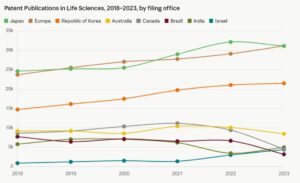
Before diving into the specific factors to consider, it is worth taking a look at the available data on where life sciences patents are actually being filed. The WIPO IP Statistics Data Center is an invaluable resource in this regard, offering a wealth of information on global patent filing trends broken down by technology area, filing office, and applicant origin, among other variables. Drawing on this data, the figures below show the total number of patent applications in the life sciences industry published between 2018 and 2023, organised by filing office. The data reveal that filings are heavily concentrated in a relatively small number of jurisdictions. The top ten jurisdictions for life sciences patent publications over this period were, in order: China; the United States; Japan; Europe; the Republic of Korea; Australia; Canada; Brazil; India; and Israel. Although these are clearly popular filing choices, the right combination of countries for any given innovation will always depend on the specific circumstances of the case.
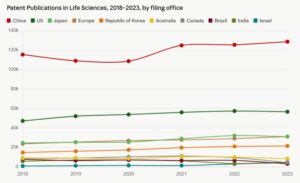
The data presented in these figures tells a clear and consistent story over the period examined. China dominates by a considerable margin, significantly outperforming all other jurisdictions in terms of life sciences patent applications published throughout the entire 2018–2023 period, with a particularly sharp increase observed around 2020–2021 — notably coinciding with the onset of the COVID-19 pandemic. The United States follows in second place, though with roughly half the number of publications compared to China, illustrating just how pronounced China’s lead has become.
When China and the United States are removed from the picture, as shown in the second figure, the separation between the remaining eight jurisdictions becomes clearer. Japan and Europe occupy the next tier, with filings in broadly comparable numbers and both showing a steady upward trend over the period. The Republic of Korea follows closely behind, exhibiting a similar trajectory of consistent growth. At the other end of the spectrum, modest declines can be observed in Canada, Brazil, and India over the same timeframe. One trend worth highlighting is the steady uptick in filings in Israel since 2021 — a relatively small but notable rise that may reflect growing confidence in Israel as a strategic filing destination for life sciences innovations.

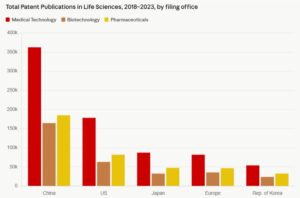
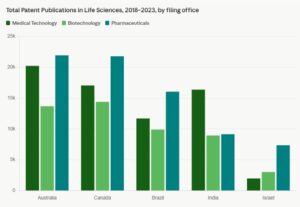
When the data are broken down by technology area — namely medical technology, biotechnology, and pharmaceuticals – an interesting pattern emerges.
For the top five performing jurisdictions (China, the United States, Japan, Europe, and the Republic of Korea), the high overall filing numbers are predominantly driven by patent publications in the medical technology field, which dwarfs the other two categories in each case. This suggests that the dominance of these jurisdictions in the global rankings is to a significant extent a reflection of their outsized activity in medical technology specifically, rather than an evenly distributed strength across the life sciences as a whole.
The picture looks rather different for the remaining five countries in the top ten (Australia, Canada, Brazil, India, and Israel). Here, the filing numbers tend to be more evenly spread across the three technology areas, often with a modest preference for pharmaceutical filings. For companies operating in the life sciences sector in particular, this distinction is a useful reminder that raw filing totals tell only part of the story; the technology-specific breakdown can offer a more nuanced and relevant guide to where innovation in a particular field is most actively being protected.
Commercial factors:
1. The need for exclusivity
Perhaps the most fundamental commercial factor to consider is where you actually need exclusivity — that is, where you intend to commercialise your innovation and establish your monopoly position. Under patent law, a patent owner typically has the right to prevent third parties from making, selling, offering to sell, using, or importing a patented product without their consent, and it is this exclusivity that underpins the commercial value of the patent. Therefore, identifying the relevant jurisdictions to seek patent protection requires thinking beyond just where the finished product will ultimately be sold. The complete supply chain must be carefully mapped: where are raw materials sourced? Where is manufacturing carried out, both at small scale and industrial scale? Where is the product packaged and labelled? Each of these activities may represent a point of vulnerability if left unprotected. In addition, the geographic footprint of your collaborators, partners — such as contract development and manufacturing organisations (CDMOs) — and licensees must also be taken into account; these parties will require confidence that their own activities are adequately shielded from third-party interference.
2. Market size
Closely linked to the question of where exclusivity is needed is a more granular commercial calculation: does the likely return on investment in any given jurisdiction justify the cost of securing and maintaining patent protection there? At first glance, the answer may seem straightforward — large, populous markets such as China and the United States, with their vast patient populations, will almost always warrant serious consideration. However, market size is not purely a function of population, and for certain innovations, smaller countries may represent disproportionately significant commercial opportunities. A particularly important consideration in this regard is the subject matter of the innovation itself, since the commercial landscape for a given technology can vary considerably depending on the legal, regulatory, and scientific infrastructure of each jurisdiction. For example, research into human embryo development is only permitted in certain countries; where such research is legally sanctioned, the supporting infrastructure is already in place, societal acceptance tends to be higher, and early commercialisation of related technologies — such as IVF innovations or mitochondrial replacement therapies — is consequently more likely to occur there first. Similarly, the legality of certain substances varies significantly across jurisdictions and can have a direct bearing on market opportunity; countries that permit the medical use of cannabis, for instance, are far more likely to foster the development and commercialisation of innovative treatments involving those substances. The key takeaway is that market size must always be assessed through the lens of the specific innovation in question, rather than by reference to general economic indicators alone.
Patent-specific factors:
3. Enforceability
In many instances, a granted patent serves as an effective deterrent in its own right — publicly delineating the scope of a patent owner’s monopoly and either dissuading competitors from entering that space entirely or at least slowing their progress. Patents can also function as powerful negotiating tools, enabling companies to enter into cross-licensing arrangements that provide access to third-party technologies whilst offering something of value in return. Ultimately, however, and particularly for those operating in crowded and competitive technology spaces, a patent is only as valuable as your ability to enforce it — and this is where the choice of jurisdiction becomes critically important. The enforceability of a patent varies considerably from country to country, across a number of dimensions:
- The experience and technical sophistication of the courts is one such factor; jurisdictions with dedicated patent courts or specialist judges — such as the United Kingdom, Germany, and the recently established Unified Patent Court (UPC) in Europe, as well as the United States — tend to offer more predictable and reliable outcomes in enforcement disputes.
- The availability of prompt and effective remedies is equally important; interim injunctions, for example, can be vital in preventing ongoing harm whilst litigation is resolved, but the ease with which these can be obtained differs markedly between jurisdictions.
- The cost of litigation is another practical consideration, with patent disputes in the United States notoriously expensive compared to many European jurisdictions.
- The scope of the discovery process also varies, and can have a direct bearing on the enforceability of certain claim types — process claims, for instance, may be significantly harder to enforce in jurisdictions where pre-trial disclosure obligations are limited and a competitor’s manufacturing process is difficult to scrutinise.
- Another consideration concerns the doctrine of prosecution history estoppel — whereby statements or amendments made during patent prosecution can be used to limit the scope of protection later asserted in litigation; this doctrine is applied differently across jurisdictions, and its potential impact on enforceability should be factored into a filing and prosecution strategy from the outset.
A related factor that can influence enforceability is the availability of compulsory licenses. Compulsory licensing is a government-authorised practice that allows a third party to produce or use a patented product or process without the consent of the patent owner, typically in exchange for a royalty. Depending on the country, compulsory licenses may be authorised if the patent has not been worked for a number of years; in a national emergency (e.g. public health emergency); or if deemed to be in the public interest. Notably, since 2022, and in retaliation to Western economic sanctions, the Russian Government has adopted a decree which allows local companies and individuals to use patented inventions held by owners from “unfriendly countries” without their consent and without paying any compensation. This practice may be rare, but clearly has significant consequences for patent owners.
A further consideration for the life sciences sector is the Bolar exemption. The Bolar exemption is a legal “safe harbor” in patent law that permits generic and biosimilar drug manufacturers to perform certain activities before patent expiry without it being considered as patent infringement. New pharmaceutical legislation in Europe intends to expand the scope of activities that fall within the safe harbor to include not only activities for obtaining marketing authorizations, but also for conducting health technology assessments, obtaining pricing and reimbursement approvals, and submitting applications on procurement tenders. Such activities would be explicitly exempt from intellectual property infringement proceedings under the new legislation.
4. Patentee-friendly jurisdictions
Closely related to the question of enforceability is the broader notion that some jurisdictions are inherently more patentee-friendly than others. This disposition can manifest at two distinct stages: during prosecution, in terms of how sympathetically patent examiners approach the claims, and during litigation, in terms of whether courts tend to give the patentee the benefit of the doubt and whether there exists a presumption of validity that a challenger must affirmatively overcome. What makes this consideration particularly complex, however, is that a jurisdiction’s patentee-friendliness is not a fixed characteristic — it can shift in response to the evolving political and policy landscape. This is especially pronounced in the life sciences sector, where governments are perpetually trying to strike a balance between the competing interests of innovator companies on the one hand, and generic or biosimilar manufacturers on the other. The former depend on strong patent protection that rewards investment in research and development; the latter depend on a legal environment that facilitates market entry, ultimately to increase competition and drive down prices for patients. The result is something of a policy pendulum, with the courts and legislatures of many countries oscillating over time between periods of pronounced patentee-friendliness and periods where the balance tips more firmly in favour of third parties, whether opponents in post-grant proceedings or alleged infringers in litigation. Public attitudes towards the patent system can further influence this dynamic; in lower-income countries with large populations and limited healthcare infrastructure, patent monopolies are often perceived as restricting access to essential medicines, and this sentiment can translate directly into policy decisions and judicial culture that are less sympathetic to patent owners. All of this is important to be aware of when developing a filing strategy — though it is equally important to acknowledge its limits as a predictive tool. With a patent term of twenty years, it is inherently difficult to forecast how these shifts will play out over the full life of a patent, and a strategy built too heavily on current judicial sentiment may look quite different by the time enforcement becomes necessary.
5. Quality, time and cost of prosecution
A more straightforward set of metrics to consider are the quality, time, and cost associated with prosecuting a patent application in each target jurisdiction. On the cost side, one of the most significant variables is the requirement for translation — many countries require not only the patent specification itself to be filed in the local language, but also all subsequent correspondence, responses to office actions, and other prosecution documents. In jurisdictions where this applies, translation costs alone can represent a substantial portion of the overall prosecution budget, particularly for complex life sciences applications with lengthy specifications. Time to grant is another critical factor. Many patent offices are currently operating with considerable examination backlogs meaning that obtaining a granted patent can take significantly longer in some jurisdictions than others. For example, despite efforts to reduce the backlog, the Brazilian Patent and Trademark Office is taking an average of just over nine years to grant a biopharma patent. Where a swift grant is desirable — for instance, to provide certainty for investors or to support licensing negotiations — duration of prosecution can be a meaningful consideration in prioritising where to file.
The quality of examination also varies widely across the world. Some offices conduct rigorous search and substantive examination procedures, providing a higher degree of confidence that any patent granted will be robust and defensible; others assess little more than formal filing requirements, with no substantive examination at all. Whilst a granted patent from the latter may appear attractive in the short term, it may offer less reliable protection in practice. Finally, regional or centralised patent offices are well worth factoring into any filing strategy, as they can offer considerable efficiency savings. The European Patent Office (EPO), the Eurasian Patent Office (EAPO), and the African Regional Intellectual Property Organization (ARIPO) are notable examples, each providing a single examination procedure prior to validation across multiple member states — significantly reducing both the cost and administrative burden of obtaining broad geographic coverage.
6. Patentability restrictions
Many of the core patentability requirements — such as the assessment of novelty and inventive step — are largely harmonised across jurisdictions. However, patent offices around the world have different perspectives on what constitutes “patent-eligible subject matter”. This divergence is particularly pronounced in the life sciences field. The patentability of therapeutic methods is a prime example; some countries do not permit claims directed to methods of treatment at all, whilst others allow product claims limited by their intended use in treating a specified disease, and others still permit broader claims directed to methods of obtaining a functional biological effect in a subject in need thereof, irrespective of a particular disease context. Beyond methods of treatment, a wide range of other subject matter categories are treated inconsistently across jurisdictions. These include, but are not limited to: dosing regimens; new routes of administration; formulations; polymorphs; new patient groups; isolated human DNA segments; methods of diagnosis; methods of agriculture or horticulture; and epitope-defined antibody claims.
In relation to the life sciences sector, a World Trade Organization waiver is currently in place ensuring that the world’s least developed countries (LDCs) are exempt from granting (and enforcing) pharmaceutical patents until 2033. Interestingly, Cambodia is currently on the LDC list, yet is also a validation state of the European Patent Convention (EPC), meaning that a European pharmaceutical patent could be validated in Cambodia, but due to local patentability restrictions, could not take effect until the waiver period has expired.
In some instances, the exclusion of certain subject matter is well-established, allowing applicants to plan accordingly; in others, the position is less certain — grant may be possible, but prosecution may be difficult/lengthy with no guarantee of a favourable outcome. The choice of filing jurisdiction must therefore be informed by the specific nature of the invention in question, since the same application may enjoy robust protection in one country and face insurmountable obstacles in another. As noted above, these restrictions are not always static, and shifts in the political or regulatory landscape can alter the patentability landscape in ways that are difficult to anticipate. For example, Argentina has just repealed a key Resolution that has imposed significant patentability restrictions in the biotechnology field for years, instantly making the country a more attractive filing option for the life sciences industry.
7. Patent extensions and other forms of exclusivity
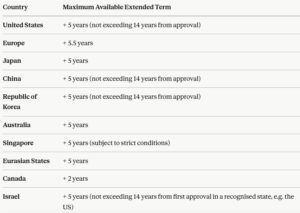
A consideration that is particularly unique to the life sciences sector is the availability of certain types of patent term extensions, as well as distinct forms of exclusivity that operate independently of patent rights altogether. Taking patent term extensions first: many medicinal products require a marketing authorisation from the relevant national or regional regulatory authority before they can be placed on the market, and it is widely recognised that obtaining such approval can consume a significant portion of a patent’s effective term — a period during which the patent holder is unable to commercialise their invention and benefit from their monopoly. In response, many countries have introduced mechanisms to compensate patent holders for this lost time, in the form of patent term extensions (PTEs) or supplementary protection certificates (SPCs), both of which provide additional exclusivity extending beyond the standard twenty-year patent term. In Europe, for example, an SPC can provide up to five years of additional protection, with a further six-month extension available where paediatric data has been generated; eligibility requires both a valid patent and a valid marketing authorisation in the relevant European Patent Convention (EPC) member state. The table below summarises the PTE and SPC provisions available across a number of key jurisdictions:
Whether a target jurisdiction offers any form of patent term compensation is therefore an important consideration in the overall filing strategy, particularly for innovations likely to face a lengthy regulatory pathway before reaching the market.
Entirely separate from patent term extensions, many countries also provide for regulatory exclusivity — a form of protection that attaches to the marketing authorisation itself rather than to any underlying patent. This typically takes one of two forms: data exclusivity, which prevents third parties from relying upon the originator’s clinical and regulatory data to support their own regulatory applications for a defined period, and marketing exclusivity, which goes further by preventing the placement of competing products — such as generics or biosimilars — on the market for a specified time. This regulatory exclusivity is distinct from, though may run in parallel with, any patent protection that is in force. When assessing a target jurisdiction, it is therefore worth considering whether that country provides any regulatory exclusivity provisions, since even where patent protection is limited or absent, regulatory exclusivity can provide a meaningful period of market protection to delay generic or biosimilar competition.
8. Foreign filing licences
In some instances, the country in which a patent application is first filed is not simply a matter of strategic choice — it may be a legal requirement. A number of countries mandate that an invention’s initial patent application must be filed within their own jurisdiction, or alternatively that a foreign filing licence must be obtained before any application is made overseas. This requirement is typically imposed to prevent the unauthorised disclosure of information considered sensitive or pertinent to national security. The precise scope of the obligation varies from country to country. In the United Kingdom, for example, the restriction applies where the invention involves military technology, national security considerations, or matters that could endanger the public; in such cases, a UK resident must either file first at the UK Intellectual Property Office and wait six weeks before filing abroad, or obtain an express foreign filing licence. In the United States and China, the requirement is broader in scope: for any invention made on local soil, the applicant is legally obliged to file domestically first, or to obtain a foreign filing licence, regardless of the subject matter of the invention. Critically, this obligation is triggered by where the inventors were physically located at the time the invention was made, rather than by the nationality or residency of the applicant — a distinction that is easy to overlook, particularly in the context of multinational research collaborations. The consequences of non-compliance can be severe and vary between jurisdictions; in some countries, failure to observe a foreign filing mandate can result in the invalidation of the corresponding domestic patent, whilst in others it may attract criminal sanctions or substantial financial penalties. Before embarking on any international filing strategy, it is therefore essential to consider the nationalities and residencies of all applicants as well as inventors involved, establish where the invention was made, and determine whether any foreign filing restrictions apply.
Conclusion
The factors outlined above provide a framework covering just some of the commercial and patent-specific considerations that life sciences companies should take into account when determining where to file. It is worth emphasising, however, that whilst the initial decision of where to file may feel like a fixed one, international patent strategy is not a one-time exercise — it is an ongoing process that demands regular reassessment throughout the innovation lifecycle. Decisions about where to continue prosecution, where to request examination, and where to continue paying renewal fees must be revisited periodically, and the answers may change as the commercial landscape evolves. A market that appeared attractive at the time of filing may have diminished in relevance by the time grant is achieved. It is therefore advisable to undertake regular reviews of the patent portfolio as a whole, asking at each stage whether the protection in place continues to provide adequate coverage, whether the investment in each jurisdiction remains justified by the likely return, and whether the portfolio as a whole remains aligned with the company’s broader commercial strategy. Patent strategy, at its best, is a dynamic and responsive discipline — and in an industry as fast-moving and competitive as the life sciences, the ability to adapt that strategy in light of changing circumstances can be immensely valuable.
(This article was originally published by Lawtext Publishing in Bioscience Law Review Volume 20 Issue 2.)