The UKIPO has published a new Designs Practice Notice (DPN), providing much needed guidance on the protection of GUIs and animated sequences using Registered Designs. The DPN can be found here , and images from the DPN have been reproduced in this article.
Previously, the Registered Designs Examination Practice Guide had been a little light on detail in relation to this rapidly growing practice area, stating that although Section 1(3) of the Registered Designs Act 1949 specifically excludes computer programs from protection, it was possible to protect the visual appearance of computer icons, screen saver graphics, GUIs and web-pages, including animated screensavers and ‘dynamic icons’. In practice, however, we have seen many objections to animated designs by the UKIPO without clear guidance for the reasoning behind such objections being available.
The new guidance provides some more (non-disclaimed!) colour to the guidance. The provision of this extra guidance is useful, but it does confirm the strict approach the UKIPO is presently taking which is out-of-kilter with other major patent offices.
Animated Sequences
The first point to note is that the UKIPO is clear that over the longer term, they are considering accepting animated file formats, but that this is not something that will be introduced for the foreseeable future. There is therefore no change in this regard; animated design sequences must still be protected by filing a number of static representations. The EUIPO Phase 2 reform is coming into effect on 1 July 2026, which should allow for filing of such animated file formats. Hopefully the UKIPO will allow these relatively soon to enhance harmonisation with the EUIPO.
Regardless of the nature of the design being protected, a registered design must convey a clear overall impression to both the registrar and third parties, and be a single, unitary design. From the guidance, it does seem that the default assumption of the UKIPO will be that a design is not animated unless the application makes clear that protection is sought for an animated sequence.
Filing Strategy
The UKIPO guidance highlights that the clear overall impression should be conveyed by providing appropriate wording when providing the Indication of Product for the application. For example, by using a Product Indication of “animated graphic user interface” or “animated graphic icon”. The Product Indication doesn’t directly impact on the scope a registered design, but this is another example of how selecting the correct Product Indication can be hugely important.
Additionally, separate views should be used for each step in the animation. The views should show clearly how the animation progresses through its various stages. The UKIPO allows for up to 12 views per design when filing Online using the web form, and no limit on the number of views when filing a “paper” application (a PDF emailed to the UKIPO). The new DPN might mean that for certain designs, more than 12 views are required to fully define the scope of protection sought, and so a “paper” filing might become important.
The DPN also confirms recent UKIPO practice that the written disclaimer can be used to define the animated sequence. This has been the informal practice of the UKIPO for a while, but it is encouraging to see it formalised. Traditionally, the written disclaimer has been used to indicate parts of the design which are not claimed (such as colour, or broken line sections), typically claimed in the negative – i.e. “no claim is made for the features shown in broken lines”. The DPN is clear that wider terminology can be used to clarify an animated sequences, such as “animation which flicks instantaneously between one still to the next”.
As these changes will mean that the UK application may be filed with different details and views when compared to an earlier priority application, some thought will also need to be put into whether or not the priority claim is valid. The concept of priority validity in registered designs is a relatively un-explored area in UK case law – particularly when there is any deviation between the original application and the priority-claiming application.
Re-dating of Registered Design Application
Importantly, the UKIPO has highlighted that while it may be possible to address an objection to an animated sequence by introducing a new disclaimer, or indeed by adding new intermediate representations, doing so introduces a risk of the application being re-dated if this significantly alters the design.
This could have serious consequences if the design is claiming priority, relying on the grace period for earlier Applicant disclosures, or if the design has been disclosed in the period between the original filing date and the re-dating date.
Applicants therefore need to take particular care when preparing a UK application for an animated sequence for filing. Best-practice will be to include more images, and to include a reference to the animated sequence in the disclaimer.
Examples of Animated Sequences
The DPN does provide some examples of what they may consider acceptable or not, some of which we have discussed below:

For the first example, shown above, the UKIPO has noted that, provided that the application is filed with an indication that protection is sought for an animated design, and that each stage of the sequence is filed as a separate representation, this would be an acceptable design. This design would be acceptable even without the use of a disclaimer, since it is easy for a third party to understand how the sequence progresses from one view to the next. As a result, the order of filing of views takes on increased importance when filing registered design applications for animated sequences.
In contrast, the UKIPO have indicated that the images below do not form such a sequence:

The lack of clear progression from one image to the next means that for this application to be accepted, a written disclaimer explaining the progression would be required; although even then, for the application to be allowable the images and the disclaimer must allow a third party to understand the overall impression of the design from the information on the register.
The UKIPO have indicated that a disclaimer could be used to resolve such an objection. However, the disclaimer proposed in the DPN would be quite limiting – “an animation which flicks instantaneously between one still to the next”. The reference to flicking instantaneously would affect the scope of the registered design, perhaps in a manner not intended by the Applicant. Further, the subsequent addition of a more complicated disclaimer explaining the transition, or the addition of intermediate images to explain the transition, would likely be considered to necessitate re-dating of the registered design.
This also highlights the situation where the priority claim might be brought into question – is the priority application similarly limited to an instantaneous flick? If not, then can the UK application validly claim the priority filing date? In this case the Applicant would argue that an instantaneous flick is at least encompassed by the original design. It may be that we begin to see case law develop in this area which is somewhat analogous to the EPO’s consideration of “intermediate generalisations” for patents, but rather than arguments that features of a particular embodiment are structurally and/or functionally linked to other features, the arguments will centre on what features can be isolated from an earlier design filing.
Graphical User Interfaces
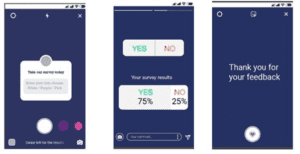
In relation to GUIs, the UKIPO have clarified that the set of images below, showing different screens from the same fictitious mobile application could not be protected as a single design, since the overall impression is not of a single, unitary design.
Interestingly, they have not suggested that this could be overcome by the use of a disclaimer. This could well mean that a design for the sequence of images which would be protectable in many other territories would not be acceptable in the UKIPO.
In contrast, these three images are protectable (subject to meeting the requirements of novelty and individual character) as three individual registered designs.
Again, a question about the validity of a priority claim could also arise here. The priority application has protection for the three images in a sequence. The UK individual designs would thus be broader in some circumstances since each individual image would be considered in isolation, and not in the context of the entire sequence.
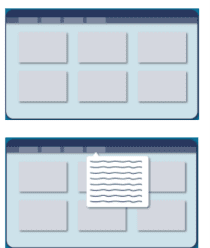
However, if a GUI contains a simple animation, such as a pop-up box, the guidance suggests that these applications may be protected as a single design.
Again, the requirement is that the different views are unitary; so complex arrangements of pop-up boxes may also require multiple design applications.
Hague Applications
One of the options to address an objection from the UK Examiner that a design as filed relates to multiple individual designs is to split the application up into multiple divisional applications. This could be useful, for example, in relation to the first GUI example above.
However, if the UK is designated in a Hague design application, it is not presently possible to file a divisional application. Therefore, if the first example GUI was filed in a Hague application designating the UK, then the Applicant would be limited to protecting a single one of these screens, and abandoning the rest, in the event that the UKIPO raised an objection to there being multiple designs.
In our view, the UKIPO needs to reform its practice in this regard to make it such that the remedies available, such as divisionals, for a Hague application designating the UK are the same as those for UK national filings. In the meantime, Applicants need to be very careful when considering a Hague application designating the UK for a GUI or animated sequence. At present, best practice is typically going to be to not include the UK in the Hague application for a GUI or animated sequence and instead file a separate national UK registered design application.
Summary
This new Practice Note provides some much-needed detail for applicants looking to protect animated or otherwise digitally-based designs in the UK. However, it highlights the divergent practice between the UKIPO and, for example, the EUIPO. Applicants need to take particular care when filing in the UK – and carefully consider their Product Indication, Disclaimer, and selected views.
The concept of design priority will also need further thought, and I expect this to be explored in case law in the not-too-distant future.
We regularly advise on UK and international design filing strategies for physical and digital products. If you would like to discuss design protection for your products, please email boult@boult.com.
This article contains public sector information licensed under the Open Government Licence v3.0.