I have written previously an article about the difficulties Lego has faced in securing Registered European Union Designs (REUDs) before the EU Intellectual Property Office (EUIPO). As noted in that article, I am a self-confessed Adult Fan of Lego, with a collection that has grown to an unsustainable size in our current house.
Against that background, I was particularly interested to see the decision at the start of 2026 in T‑628/24 from the General Court. Lego had applied to annul a decision of the EUIPO Board of Appeal (Case R 162/2023-3), which had revoked Lego’s REUD 001050645-0003.
The contested Registered EU Design
The REUD in issue relates to a specific Lego part described, using Lego’s well-established taxonomy, as a “Plate, Modified 1 x 2 with Clip on End (Horizontal Grip)”. For readers whose Lego experience may not have extended beyond childhood, this terminology warrants some explanation.
A “plate” is a studded part that is one third of the height of a standard brick. It is described as “modified” because it departs from a strictly rectangular form. “1 x 2” refers to the footprint of the part, being one stud wide and two studs long. Finally, “Clip on End (Horizontal Grip)” describes the modification itself, namely a clip at one end of the plate designed to hold a bar parallel to the plate’s surface. These individual parts are traded and identified independently on platforms such as BrickLink, where this particular element is listed as Part No. 63868.
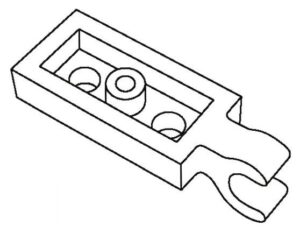
Turning to the REUD, this is what that looks like:
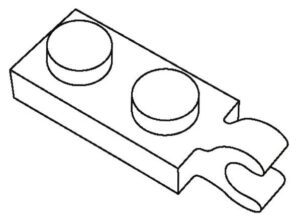
The scope of protection of an REUD is defined by the images filed, and it extends to any identical design or to any design that does not produce a different overall impression on the informed user. For an REUD to be valid, it must be new and have individual character, with individual character similarly assessed by reference to whether it produces a different overall impression from earlier designs.
The prior art brick design
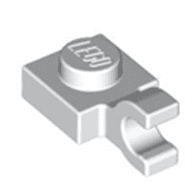
The present case is an appeal from the EUIPO’s finding that the REUD lacks individual character over an earlier Lego design, described as a “Plate, Modified 1 x 1 with U Clip (Horizontal Grip)” (Part No. 61252). While the precise characterisation of the clip differs slightly, the most obvious distinction between the two designs is that the earlier part is a 1 x 1 plate rather than a 1 x 2 plate. For ease of reference, I will refer to this earlier design as the “1 x 1 plate”.
Visually, this 1 x 1 plate looks like:

The earlier decisions
Both the first-instance invalidity decision and the Board of Appeal at the EUIPO concluded that the REUD did not produce a different overall impression from the 1 x 1 plate. The General Court has now upheld that assessment.
At the heart of Lego’s case were two alleged differences between the designs. First, Lego relied on the oblong shape (a rectangle with four right angles and unequal adjacent sides) of the contested design as opposed to the square shape of the earlier design, together with differences in the number and proportions of elements such as the studs. Second, Lego argued that the Board of Appeal failed to take proper account of differences visible in the underside views, in particular the presence in the contested design of a prominent cylindrical element that is entirely absent from the earlier design.
The central question: who is the informed user?
Before turning to these points individually, it is worth highlighting what is, in my view, the central issue underlying the decision: the identification of the informed user. The Board of Appeal defined the informed user as someone who “habitually purchases [building blocks from a toy building set], puts them to their intended use, possesses a certain degree of knowledge with regard to the features that those designs normally include and has become informed on the subject by browsing through catalogues of or featuring, building blocks from a toy building set, downloading information from the internet or searching for it via any other means”.
However, I think that in formulating this definition of the informed user, a proper consideration of what product they are actually the user of has not been performed. This identification of the informed user seems to be influenced by an implicit assumption that the informed user is primarily concerned with the use of Lego bricks within assembled models or sets, instead of individual bricks themselves.
The REUD is for an individual Lego brick, not for a Lego set. Individual bricks are bought and sold separately in large volumes by a substantial community of users. Platforms such as BrickLink alone have hundreds of thousands of members who purchase individual elements with a high degree of attention and familiarity. Indeed, this market is so significant that Lego themselves purchased BrickLink in 2019. This context is critical when assessing overall impression.
The lower cylinder or tube
Starting with the second alleged difference, this concerns the presence of a bottom tube on the underside of the 1 x 2 plate. This cylindrical element contributes to the “clutch power” of the part, improving how it holds together with other bricks. The General Court treated this feature as a minor element of the overall impression, noting in particular that it would be hidden for much of the product’s use when the plate is connected to another element.
However, for a correctly-identified informed user who purchases individual bricks , the presence or absence of a bottom tube is neither incidental nor negligible. Indeed, within Lego’s own taxonomy there are distinct categories for parts of identical footprint that differ only in whether a bottom tube is present. In that context, the underside structure is a visually meaningful aspect of the design.
I think that the particular focus given to the feature being hidden when assembled highlights this issue with the informed user – it focuses on the end assembled set and not the individual brick the subject of the REUD. I also think that it shows some inexperience in the consideration of Lego sets – there are many sets where the underside of bricks are visible in the assembled set. For example, in sets designed for playing which open up, or where a more “industrial” look is the goal.
Neither the Board of Appeal nor the General Court directly addresses this distinction in the identity of the informed user, and as a result the weight given to this feature appears understated.
When does a square produce the same overall impression as an oblong?
Similar concerns arise in relation to the first alleged difference. The General Court accepted that the difference between a 1 x 1 square plate and a 1 x 2 oblong plate does not produce a different overall impression on the informed user. That conclusion is difficult to reconcile with the Court’s own definition of that user. As noted at paragraph 25 of the judgment, the informed user is someone who habitually purchases such items, possesses a certain degree of knowledge of the features normally included in those designs, and shows a relatively high level of attention.
As established in PepsiCo v Grupo Promer Mon, the informed user occupies a position somewhere between the average consumer and the sectoral expert. In the context of individual Lego parts, that places the informed user firmly in a community of purchasers who are highly familiar with the minutiae of brick design, dimensions and connectivity. The level of differentiation between parts is such that an extensive and precise taxonomy has developed, and experienced users can visualise a specific element purely from its written description.
This is a user community where discussions about so-called “illegal” building techniques are commonplace. These do not, of course, result in anyone being sent to Lego jail, but rather in undue mechanical stress being placed on particular components when attached together in ways that, while possible, are not recommended. For an informed user operating at that level of knowledge and attention, the distinction between a 1 x 1 square plate and a 1 x 2 oblong plate is not a marginal variation, but an immediately recognisable and meaningful difference that significantly contributes to the overall impression of the design.
The Board of Appeal also suggested that combining two squares naturally results in a oblong, such that the contested design could be perceived as a continuation of the same pattern established in the earlier design. That reasoning is not entirely convincing. The earlier design is not a simple square, but a modified square incorporating a clip. A true continuation of that pattern would more naturally imply the repetition of the modification, resulting in multiple clips rather than a single clip on a longer plate. Indeed, even the position of the clip is a matter of choice (as noted by this being specified in the Lego taxonomy).
Implications for EU design law and modular products
Taken together, these points make the General Court’s conclusion difficult to follow. More broadly, the decision illustrates the inherent tension in applying EU design law to modular systems composed of numerous closely related elements. While considerations of competition and market openness undoubtedly form part of the wider policy backdrop, the analysis must still be anchored in the proper identification of the informed user and a careful assessment of the overall impression created by the REUD as filed.
There is also the potential for significant deviation between UK Registered Design law and EU design law. The UK, in recent decisions, appears to be taking an approach that even very small differences can establish individual character and hence validity of a UK Registered Design. The presence of similar prior art is then used to establish the design corpus and accordingly narrow the scope of the UK Registered Design. Given the same prior art submissions and arguments, I would expect a UK decision on the validity of the corresponding UK Re-Registered Design (following Brexit) 90010506450003 would be that the design is novel and had individual character. This therefore leaves the serious possibility of the same design being valid in the UK and invalid in the EU.
The decision also underscores the challenges Lego faces in seeking design protection for individual components within a highly standardised modular system. It also raises broader questions about how finely EU design law is prepared to distinguish between closely related designs where the informed user is particularly knowledgeable and attentive.