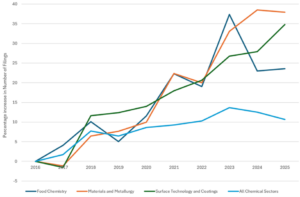
Percentage Growth in Number of EPO Patent Filings for Different Chemical Sectors
(Source: Statistics & Trends Centre | epo.org)
European patent filing trends provide valuable insight into the technologies attracting investment and where businesses see the greatest value in securing intellectual property protection.
Whilst the number of chemistry-related filings has increased by over 10% over the last decade, three sectors in particular have seen the most substantial increases in patent activity, reflecting broader trends in sustainability, energy transition and advanced manufacturing.
Materials and metallurgy sector continues strong growth
Patent activity in materials science and metallurgy has grown significantly over the last decade, with filings increasing by almost 40%. This makes materials and metallurgy one of the fastest-growing chemistry-related technology areas at the EPO.
This trend is driven by several powerful long-term factors. Developments in battery technology, electric vehicles (EVs), renewable energy infrastructure and next-generation electronic devices are creating demand for innovative advanced materials, alloys, electronic materials and specialist manufacturing processes. From smartphone displays and semiconductor components to battery systems and energy storage technologies, advances in product performance increasingly depend on breakthroughs in materials science. As governments and industry continue to invest in the energy transition and digital transformation, companies are increasingly seeking patent protection for technologies that deliver improved performance, efficiency and durability.
Sustainability is also shaping innovation priorities. Businesses are investing in lightweight materials, resource-efficient manufacturing processes and recycling technologies that support circular economy objectives. Innovation relating to critical raw materials, substitute materials and materials recovery has become increasingly important as companies seek to strengthen supply chain resilience and reduce environmental impact.
At the same time, advances in additive manufacturing and powder metallurgy are creating new opportunities for patent protection. Many innovations sit at the intersection of materials science, chemistry, engineering and process technology, generating valuable intellectual property across multiple sectors.
Materials innovation is also enabling progress in industries ranging from aerospace and electronics to semiconductors, hydrogen technologies and medical devices. As a result, materials and metallurgy has become a critical enabling technology for a wide range of deep tech industries.
Food technology sector gains momentum
Food technology represents a smaller proportion of chemistry-related filings, but recent growth trends indicate a rapidly evolving area of innovation. Filing activity has increased by almost 25% since 2016, reflecting growing investment across the sector.
One of the key drivers is changing consumer demand. Interest in health, nutrition and wellbeing continues to stimulate innovation in functional foods, ingredient technologies and health supplements. These developments create opportunities for patent protection covering ingredients, compositions and manufacturing processes.
Innovation in alternative proteins, precision fermentation and sustainable food production methods is also contributing to increased patent activity. Significant research is being directed towards improving taste, texture, nutritional performance and production efficiency, creating commercially valuable intellectual property.
Sustainability remains another major factor. Food manufacturers are investing in technologies that reduce waste, improve resource efficiency and extend product shelf life. Advances in processing technologies, enzyme systems, fermentation methods and ingredient delivery platforms are helping businesses develop more sustainable products while maintaining performance and quality.
As food innovation becomes increasingly research-intensive, patents are playing a more prominent role alongside trade secrets and manufacturing know-how. The continued increase in filings suggests that patents are becoming an increasingly important commercial asset within the food technology sector.
Growth in surface technology and coatings sector
Patent activity relating to coatings and surface technologies has also shown strong growth, increasing by approximately 35% between 2016 and 2025.
Advanced coatings play a critical role across industries including automotive, construction, energy, packaging, electronics and consumer products. Increasingly, they are being used to improve product performance, durability and sustainability without fundamentally changing the underlying material.
Much of the recent innovation has been driven by environmental and regulatory pressures. Companies are developing alternatives to legacy coating technologies while maintaining high levels of performance. This is creating significant patent opportunities for novel coating compositions, application methods and surface treatment processes.
Surface technologies are also becoming increasingly important within battery materials, renewable energy systems and hydrogen technologies. Coatings that improve corrosion resistance, thermal management, barrier performance and/or durability can provide significant commercial advantages in these rapidly growing sectors.
Another notable trend is the emergence of multifunctional coatings. Modern surface technologies may incorporate antimicrobial, self-cleaning, conductive, insulating or protective properties, broadening their application across advanced manufacturing and high-value industrial markets.
As with materials science more broadly, coatings are increasingly acting as an enabling technology that supports innovation across multiple sectors of the economy.
Looking ahead
Recent European patent filing trends point to growing opportunities in food technology, materials science, metallurgy and surface technology. This reflects the increasing importance of these sectors across the European economy.
For businesses operating in these sectors, a robust patent strategy remains an important tool for protecting innovation, attracting investment and securing long term commercial value.
At Boult, our attorneys work with clients across a broad range of chemical fields, including materials science, green technology, food and beverages and coatings. If you are interested in discussing patent protection related to chemical inventions, then please get in touch with a member of our chemicals team.
Contact Daniel Weston for food and beverage-related enquires.
Contact Dr Oliver Rutt for materials and metallurgy, coatings and surface technology, and green technology-related enquiries.