The UK’s National Energy System Operator (NESO) recently published its review of electricity generation in the UK for 2025. Last year represents a record year for the use of renewable energy sources in the UK electricity grid, with 44% of the country’s energy created from renewable sources (up from 42% in 2024).
The breakdown of how electricity was generated for the national grid is summarised in the graphic below. (Source: Britain’s Energy Explained: 2025 Review | National Energy System Operator).
Figure 1:
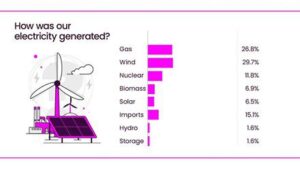
The importance of green energy sources in the make-up of the UK’s electricity generation is evident, with wind, solar and biomass production playing a key role in fuelling the grid – indeed, as will be discussed herein, more of our generated electricity came from wind than gas in 2025. With the Government continuing to prioritise reaching a “net-zero” state for energy use in the UK in the coming decades, this appears a trend which is unlikely to change.
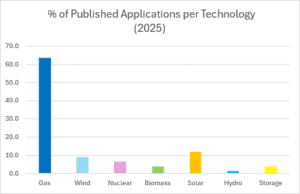
However, an examination of patent applications published in 2025 for technologies relating to the energy sources indicated the NSEO report for 2025 reveals some interesting findings about the landscape of innovation in the energy sector. This has been collated as Figure 2, below.
Figure 2:

Contrasting production with innovation: what does the patent application landscape reveal about the future of green energy in the UK?
Gas: Gas is by some distance the most common subject matter for patent applications published in 2025 across the energy sources covered by the report, representing 63.6% of the published applications identified. According to the NESO report, gas remained a significant source of the UK’s electricity output. However, the prevalence of published applications for gas-related technology demonstrates a clear discrepancy between its contribution to the UK’s electricity supply at 26.8% of the total generated and its role as a source of innovation.
The high number of gas-related patent applications may result from a few factors, including the well-established position of gas as a form of energy production, and the wide range of technologies associated with its discovery, extraction, transport, and so on. It is also possible that some of the applications relate to technologies or processes seeking to improve the sustainability or impact of gas-related electricity generation.
In any case, gas remains an enduring part of the UK’s energy production infrastructure, particularly in the north of the country from UK and Norwegian gas fields in the North Sea, so it is not surprising that this well-trodden sector remains of high interest when it comes to protecting innovation. Certainly, while a continuing push to net zero will likely see renewable energy sources be prioritised, gas generation – given its accessibility and abundance – is unlikely to disappear entirely as a source of patent applications, at least in the short term.
Wind: Perhaps the biggest takeaway from our review is the disparity between usage of wind generation and the amount of patent applications published for technologies relating to wind power. Wind was the single largest source of electricity in the UK last year, providing 29.7% of the total electrical production, ahead of gas and solar. Despite that, wind technologies appear in patent applications at a lower rate than gas (9.1%) and even solar energy (at 11.7%).
With the proven success of wind power as a source of electricity, it might prove interesting to track how the rate of applications for this sector changes in the coming years, as patent applications are typically only published around 18 months after filing. It is possible that we will see the numbers match more closely with the NESO report out as patent applications filed in 2025 start to be published from mid-2026.
Solar: Conversely, solar-related patent applications tell a different story. Despite only providing 6% of the country’s energy last year, solar energy is the second most common source of patents amongst the technologies covered (at over 11%).
That may seem slightly disproportionate, especially as the UK’s climate might not be considered especially conducive to solar energy generation. The NESO does make reference to 2025 being the sunniest year on UK records as evidence for its position in their figures, but the fact remains that the UK is a less than obvious candidate as an innovator for solar energy technologies.
However, the discrepancy might be explained by the popularity of solar as a source of patents might lie in the use of solar panels by on residential properties. The Government’s continued backing of residential green energy investments as a source of clean energy for homes will likely keep solar energy a key source of patent applications in the coming years.
A note on the Green Channel
One final comment: of the 67 patent applications identified in our search, only seven (less than 10%) are currently making use of the UK’s Green Channel to accelerate their applications. Of those seven, two related to biomass, two to hydrogen technologies and one to grid energy storage. The remaining two patent applications related to capacitors and batteries, showing how diversely the green channel criteria can be applied.
This is a surprisingly small rate of take-up by firms looking to bring renewable and green energy technology to market. There may be a few factors at play in this. For example, while the Green Channel is useful for speeding up prosecution, this can mean that an applicant in fact receives a refusal notice more quickly. A wish to avoid this outcome might be a factor in the remaining majority of these applications – which would appear at initial glance to qualify – electing not to make use of the Green Channel. Another factor may be costs: by speeding up prosecution, patent prosecution costs are also brought forward. Companies still looking for financial backing may therefore choose to let prosecution proceed at its usual pace, to provide more time.
For green energy and renewables developers considering routes for their patent applications, take a look at Boult’s guide to international fast track patent programmes for green technology.
Conclusion
The NESO’s report demonstrates the importance of renewable energy sources to the overall production of the UK’s electricity. However, a review of patent applications for the same period highlights the enduring role of gas as a tried-and-tested source of the country’s energy needs.
The success of green energy as a stable and regular source of electricity is nevertheless apparent. As the Government continues to work towards a net-zero solution for the UK, greater investment in green and alternative forms of energy generation will likely drive patent application in future years.
Boult’s green tech and renewables team encompasses experts covering emissions reduction/control products, battery storage for renewables, photovoltaics and beyond. Read more about the work of our team and contact our energy and renewable experts here.